Augusta Concrete Patios: Stamped Concrete Patios & Concrete Driveways in Augusta, GA
Augusta Concrete Patios pours stamped concrete patios, concrete driveways, walkways, steps and pool
decks across Augusta and the CSRA. Free on-site quote, usually within
two working days.
✓ Licensed and insured in Georgia
✓ Proper stone base over compacted Georgia clay
✓ Written quote, with slab thickness and base depth stated
Augusta Concrete Patios is a concrete contractor working residential and light commercial flatwork across
Augusta. Everything below is quoted free on site, and every quote states the slab thickness, the base
depth and the mix, so you can hold it next to another contractor's and compare like with like.
Breaking out and hauling away an existing slab. $2–$6 per square foot.
Why Georgia red clay decides how long a slab lasts
Augusta sits on the Georgia Piedmont, and the subgrade under almost every property here is red clay. Clay is not inert. It takes on water and swells, it dries out and shrinks, and it does that through every wet spring and dry August. A slab poured straight onto clay rides that movement, and concrete has no give in it.
The answer is the stone base, and it is why we will not quote a job without one. Four to six inches of compacted crushed stone does two jobs: it spreads the load so no single spot on the clay carries the slab, and it drains, so water moves away instead of sitting in the clay directly beneath the concrete. Skipping it is the single most common reason slabs in the CSRA crack in a straight line across the middle within a few years.
The second local factor is heat. Concrete sets by chemical reaction, and that reaction runs faster the hotter it is. On a 95-degree Augusta afternoon a slab can go from workable to unworkable in under an hour, which is how you end up with cold joints, surface crazing and a finish that never closed properly. Summer pours here start early, and the slab gets covered and kept damp while it cures rather than being left to bake.
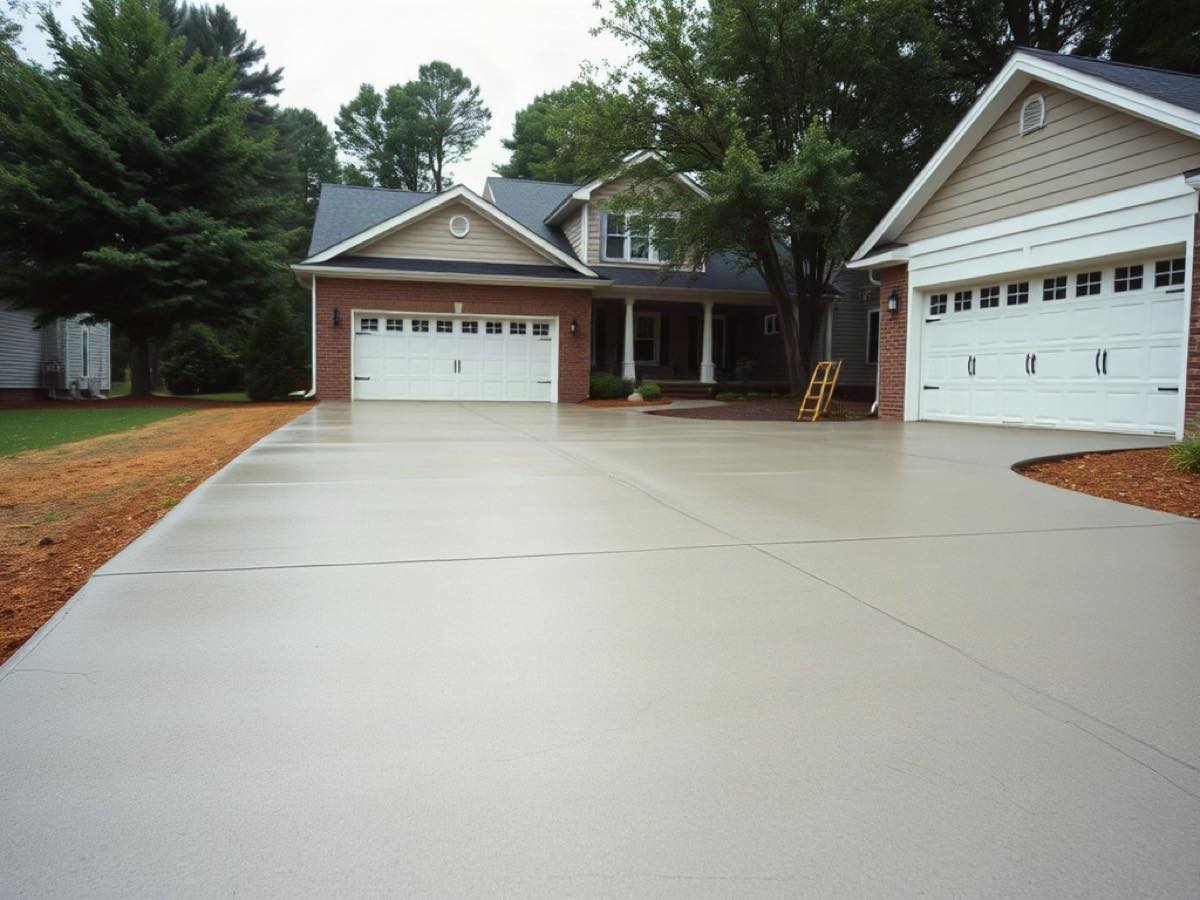
Broom-finished driveway with saw-cut control joints
How we build a slab
Subgrade. Topsoil comes off — it is organic, it compresses, and anything built on it will settle.
The exposed subgrade gets compacted in layers rather than in one pass, because a plate compactor only
influences a few inches at a time.
Stone base. Four to six inches of compacted crushed stone over the clay subgrade. The base spreads load and, just as
importantly, it drains. Skipping it is the most common way a slab that looks perfect in year one is broken
by year five.
Forms and fall. Set to shed water away from the structure. A dead-level slab holds standing water,
and standing water in January is how surfaces come apart.
Reinforcement. Fibre through the mix for patios, and for driveways #4 reinforcing bar at eighteen
inches on centre, chaired up into the slab rather than laid on the ground where it does nothing.
The pour. Continuous. A patio poured across two days has a cold joint through it, and on stamped
work that line never goes away.
Finishing. On the concrete's schedule, not ours. Float too early and you seal bleed water into the
surface, which is what makes concrete dust and flake later. Float too late and it will not close at all.
Reading that window is judgement, and it is most of what a good crew is worth.
Control joints. Cut about a quarter of the slab depth, spaced in feet at roughly two to three
times the thickness in inches — eight to twelve feet on a four-inch slab. Joints do not prevent cracking.
They choose where it happens, and a crack inside a joint is a crack nobody ever sees.
Curing. Concrete gains strength through hydration, not by drying. Keeping moisture in during the
first days matters more than anything that happens to it afterwards.
Commercial and HOA work
We handle sidewalks, ADA curb ramps,
parking areas, dumpster pads and
loading dock aprons for property managers and associations across
Augusta. On commercial work the phasing usually matters more than the price — a blocked entrance costs a
tenant far more than the slab does — so we schedule around trading hours, including overnight and weekend
pours where that is what the site needs.
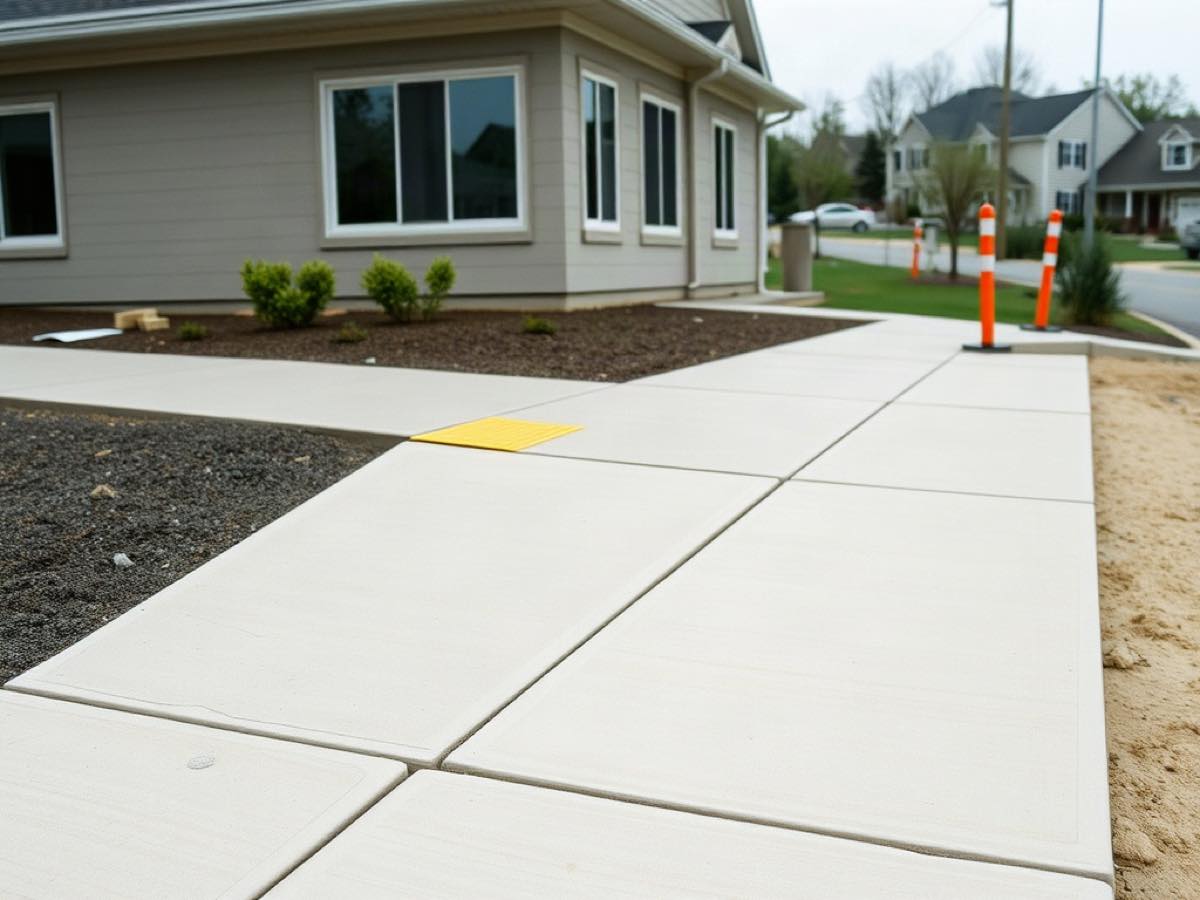
Commercial sidewalk with ADA curb ramp and detectable warning panel
What concrete costs in Augusta
Plain broom-finished patio, $6–$15 per square foot. Stamped patio, $12–$20 per square foot.
Driveway, $6–$10 per square foot plain or $10–$18 per square foot stamped, and
$8–$14 per square foot including removal if the old surface has to come out.
Steps price per step, usually $200–$450 per step.
Pool decks run $9–$18 per square foot because of the texture and the
detailing at the coping.
Four things move a number inside those ranges: the area, the finish, whether there is an existing surface
to remove, and whether a truck can reach the pour. That last one catches people out. A back garden a mixer
cannot get near means the concrete moves by wheelbarrow, and that labour is a real line on the quote rather
than a rounding error.
Most people arrive with a picture rather than a specification, which is the right way round. The
comparisons that come up most often are concrete against pavers,
concrete against asphalt, and
stamped against stained. Each of those pages sets out the real
trade-off rather than steering you toward the more expensive answer.
One piece of advice worth more than any of them: when you are shown photographs of finished work, ask to
see one that is three years old. Everything looks good freshly sealed. What matters is how a finish wears
through Georgia summers, and a three-year-old slab tells you that in a way a handover photograph cannot.
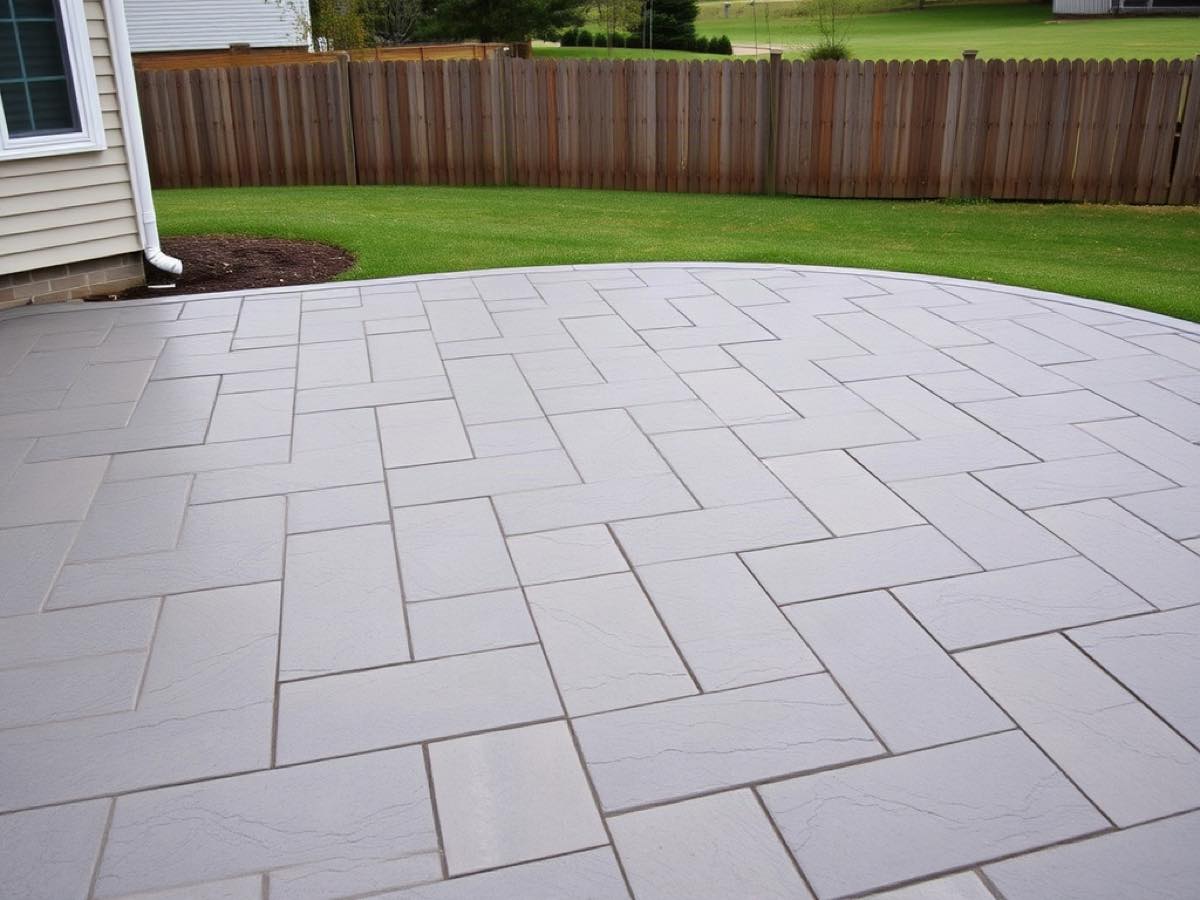
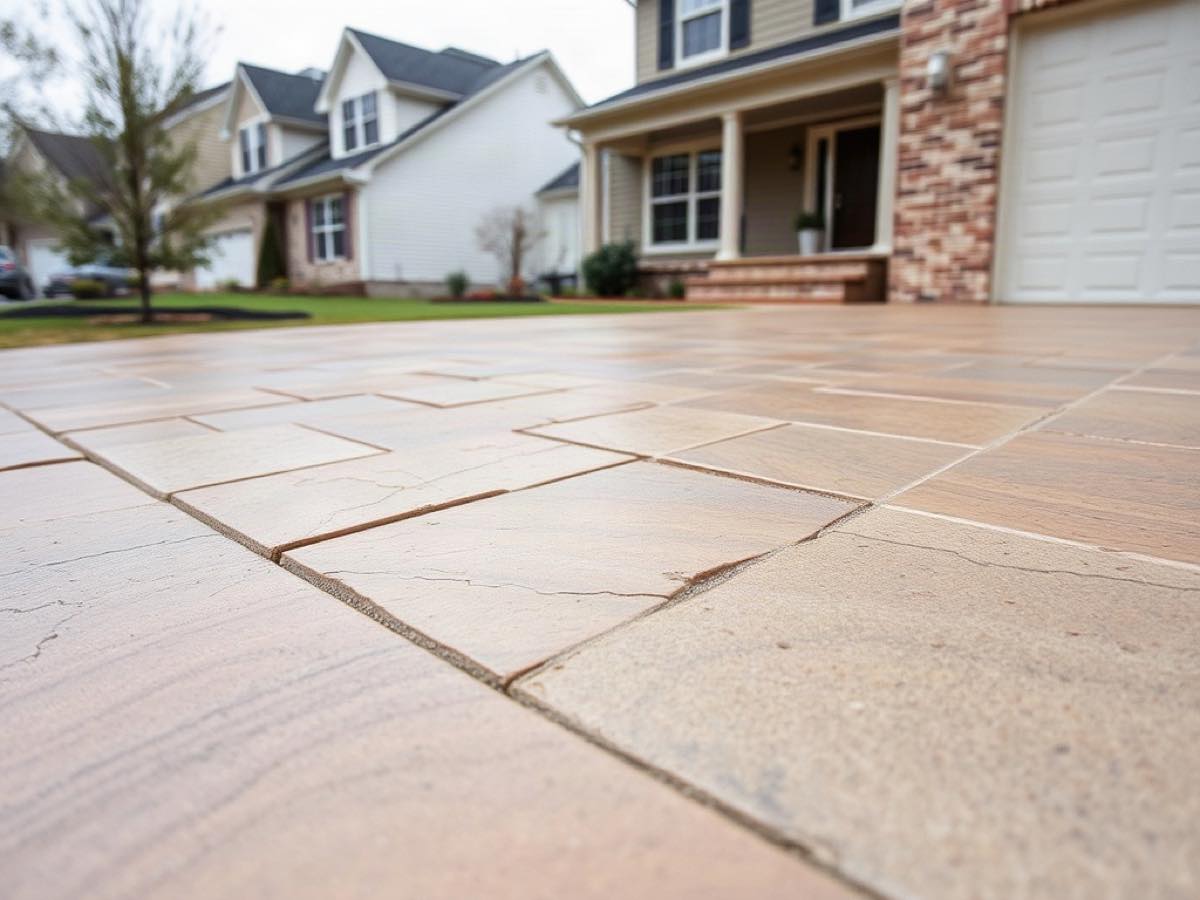
Stamped concrete texture with integral colour and antiquing release
Looking after concrete once it is down
Concrete is close to maintenance-free, but "close to" is not "entirely", and the difference shows up
after about a decade. Three things actually matter here.
Sealing. Decorative work — stamped, coloured, exposed aggregate — gets its first seal at
twenty-eight days and then roughly every two to three years. Use a penetrating silane-siloxane on anything
that gets de-iced. Film-forming acrylic looks glossier and will peel where salt gets under it, which is why
so many stamped driveways in this region look patchy by year five.
De-icers. Rock salt is the least damaging of the common options. Ammonium sulphate and ammonium
nitrate attack concrete chemically and should never go on a slab, despite being sold for exactly that.
Nothing should go on concrete in its first winter; use sand for traction instead and let the slab finish
gaining strength.
Joints. The one piece of genuine maintenance. Control joints and the expansion joint against the
house should stay filled. An open joint is a direct route for water into the base, and water in the base
sitting in the clay beneath is what lifts and cracks slabs. A tube of self-levelling sealant every few years
prevents a repair that costs thousands.
How to read a concrete quote
Most quotes in this trade are a single line and a number, which makes them impossible to compare. Four
things should be written down, and if they are not, ask.
Slab thickness. Four inches for a patio or walkway, five for a residential driveway, six where a
truck parks. A driveway quoted without a thickness is frequently four inches, which is a patio slab under a
car and will fail at the apron first.
Base depth and material. Four to six inches of compacted crushed stone over the clay. "Poured on grade"
means straight onto soil, and it means the slab moves when the soil does.
Air entrainment. Five to seven percent for exterior work. This is the specification that separates
concrete built for a freeze-thaw climate from concrete that merely survived its first summer.
Joint spacing. Should be stated, and should work out at roughly two to three times the slab
thickness in feet. Wide spacing means fewer cuts, faster work, and cracking in the middle of panels.
You are also entitled to see a Georgia contractor licence and a certificate of insurance. A contractor
who is reluctant about either is telling you something, and it is worth hearing.
Where we work
Augusta, Columbia County and Aiken County — 52 neighbourhoods and towns:
A plain broom-finished patio runs $6–$15 per square foot installed. Stamped work runs $12–$20 per square foot depending on the pattern and whether it is coloured. Those figures include the stone base, an air-entrained mix and cut control joints. Quotes well below them are usually saving money on one of those three.
How long before I can use it?
Foot traffic after about three days, furniture at seven, and cars on a new driveway at seven as well. Heavy vehicles wait twenty-eight days. Decorative work gets sealed at twenty-eight days, once the slab has cured.
Will it crack?
Every concrete slab moves, and control joints exist to decide where that movement shows. Cut at the right spacing, cracks follow the joints and stay invisible. What should not happen is a crack with one side sitting higher than the other — that is the base failing, not the concrete, and it means the ground work was skipped.
Do I need a permit?
For work in the public right of way — the sidewalk across your frontage and the driveway apron at the street — yes, and it needs inspecting afterwards. Work behind the property line usually does not, though some lots carry impervious-surface limits that a large new patio can push past. We check before quoting.
Can you pour in winter?
Yes, with adjustments. Below about 40°F concrete needs protection — heated blankets, and sometimes a mix change — and that costs more than a pour in May. We will tell you honestly whether waiting is the better call.
Do you do repairs, or only new work?
Both. Sometimes the honest answer is that a slab can be lifted back to grade or resurfaced for a fraction of replacement. If more than roughly a third of a driveway is failing, though, replacement is genuinely the cheaper route.
Get a free quote
Tell us what you need. We answer the same day, and the on-site visit is free.
Get a written quote
Call (762) 320-6343. We come out, measure, look at drainage and access, talk through
what the space is actually for, and leave you a written price with the specification on it. The visit is
free, it takes about twenty minutes, and nobody chases you afterwards.